The Symptom Is Not Separate from the Whole
When a symptom or difficulty arises, our first reaction is usually to want it to disappear, which is normal. No one consciously chooses suffering, and no one should be blamed for wanting to feel better.
Still, there may be a difference between wanting relief and entering into a war against what we are feeling, because the body is not a machine made up of isolated parts. Tension may be related to tiredness, difficulty resting may be connected to a pace of life that has already gone beyond our limits, and constant irritation may reveal an accumulation of ignored needs.
This does not mean that every symptom has only an emotional or spiritual explanation, nor does it mean that we become ill because we do not think positively. It means that it is worth observing the whole person and allowing curiosity to exist before the rush to eliminate.
“Observing is not blaming.”
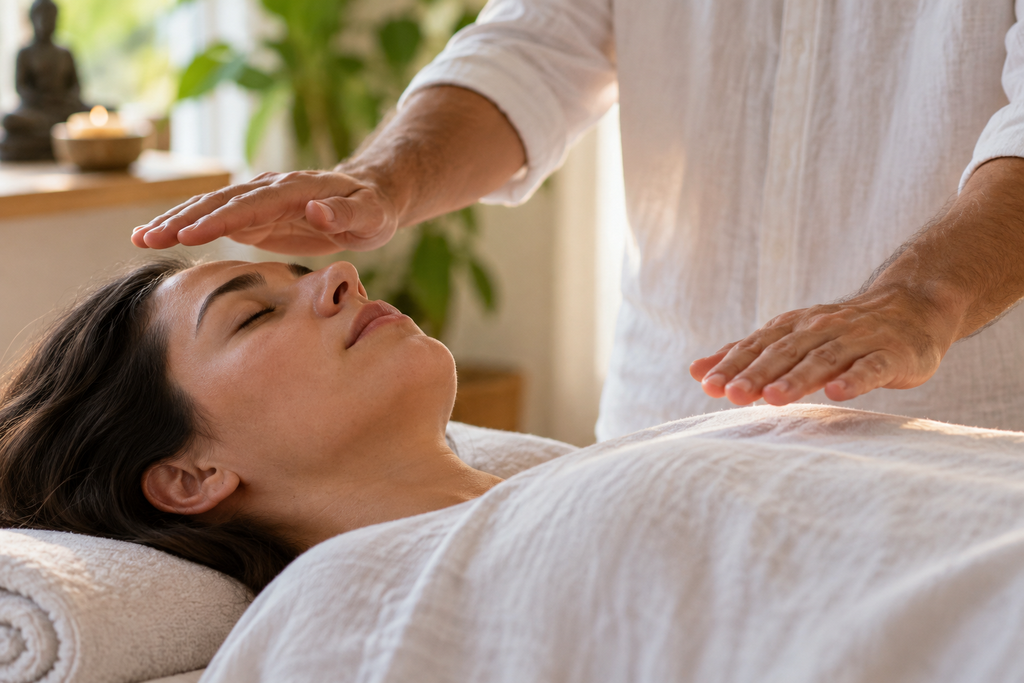
Observing is not blaming, but recognizing that something is happening and that perhaps it is important to listen to it carefully. Reiki can be experienced as an invitation to this observation, not always to find an explanation, but often to stop being completely disconnected from ourselves.
The Time of Practice
Another source of frustration is the expectation of quick results. How many sessions are needed? When will I feel a difference? How long does it take to work?
These questions make sense because we seek security, and we want to know what will happen, measure the journey, and ensure that our effort will have a reward.
But not everything that matters can be measured by the speed of the result. There are processes that begin almost invisibly, such as pausing before reacting, having a night when we manage to rest a little better, noticing that we are once again breathing more freely, having the courage to recognize that we need help, or deciding to establish a boundary. These may seem like small changes, but they can also profoundly change the way we live.
The practice does not need to become a race to reach an ideal state, and Reiki does not need to be used to prove that we are evolving. It can be a way of returning, again and again, to the basics and to what is actually happening.
Returning to the Basics
There is a tendency to think that moving forward means accumulating more knowledge, more courses, more techniques, more experiences, and more answers.
However, perhaps the path of Reiki is often a process of simplification. I say this not because knowledge is unimportant, but because there comes a point when we no longer need to add so much and need, above all, to integrate.
Returning to the basics can mean practicing regularly, feeling the hands without turning every sensation into a message, remaining in silence without searching for a special experience, caring for the body, carrying out a simple task with attention, apologizing when necessary, or resting before reaching our limit.
It is in this place that the practice stops being an activity separate from life. Reiki is not confined to the moment when we sit down to practice, because it begins to appear in the way we move through the day.
It appears in the way we listen to someone without immediately preparing a response, in the choice not to feed an argument, or in recognizing that we are demanding too much from ourselves.
“Perhaps the path of Reiki is often a process of simplification.”
About the Author
Justino Pereira lives in Vila de Rei, in the interior of Portugal. He is a Reiki practitioner, therapist, and Reiki Master, as well as the founder of Vila de Reiki, a project that seeks to offer a serene and integrated space for the practice, teaching, and communication of Reiki.
His main professional career was as a prison officer, where he spent more than a decade working in a prison environment. That time deeply marked him, placing him face to face with questions of dignity, suffering, and the possibility of human transformation. It was also during this period that he became self-taught in the field of personal development and began exploring esoteric and spiritual paths, seeking to understand what lives within us and how it relates to the way we are in the world.