Methodology and First Data from the Research on Reiki Initiation
Methodology
Within this dichotomy of traditional and scientific controversy, it is complex to carry out rigorous research and establish structured considerations in different stages without disregarding any of them in order to respond to what is intended to be expressed, since this would involve not only the statistical analysis of data supporting an adequate interpretation, but also the establishment of appropriate approaches and methodologies to avoid erroneous conclusions.
Therefore, at an initial stage, the intention is not to offer rigorous results, as established by “hard” research; nor to influence the thinking of practitioners of any Reiki system, technique, or form; but rather to establish objective determinations beyond mere descriptions, beliefs, or definitions; since there are perhaps few or no objective or observable technical investigations within the scope intended in this study — differentiated Reiki initiation rituals —, a consideration arising from the analysis of visual or printed materials that have been examined.
Therefore, this work can only be considered exploratory research with the purpose of studying the two aspects of the Reiki initiation ritual: in-person and at a distance; since the premises of the latter have so far only been expressed as considerations based on experience and opinions that have not been objectified.
“Exploratory research is considered the first scientific approach to a problem. It is used when the problem has not yet been addressed or has not been sufficiently studied and the existing conditions are not yet conclusive. This name is given to research carried out with the purpose of highlighting the fundamental aspects of a particular problem and finding appropriate procedures for developing subsequent research.”
It is useful to develop this type of research because, once its results are available, it becomes easier to open lines of research and proceed with their subsequent verification.
“The objective of this method is to explore the problem and its environment, and not to draw a conclusion from it. Furthermore, it will allow the researcher to establish a solid foundation for exploring ideas, choosing the appropriate research design, and identifying the variables that are truly important for the analysis.”
Exploratory research has multiple characteristics that give it advantages over other methods. The main ones are:
- By defining its concepts, it prioritizes people’s points of view.
- It is focused on the knowledge available about a subject.
- It has no mandatory structure.
- It finds a solution to problems that were not taken into account in the past.
For the considerations of the following study, a large-scale random sampling of participants was not carried out, since this would have involved long-term work; the collaborators are students of the Reiki CEAAN school from different cities in the state of Guanajuato, Mexico; with different degrees of initiation and/or preparing to be initiated (new students).
The results of the complete study involve, in addition to the initiation ritual, the study of different Reiki application techniques, results that are not considered in the present document and will be presented in a second volume, but taking into account the theoretical foundations presented in this text, which ultimately will only be an extension of the same study.
Observation of the Initiation Processes
The observations of Reiki initiation in in-person and distance ceremonial rituals were carried out through the energetic manifestations of the auric field during initiation processes.
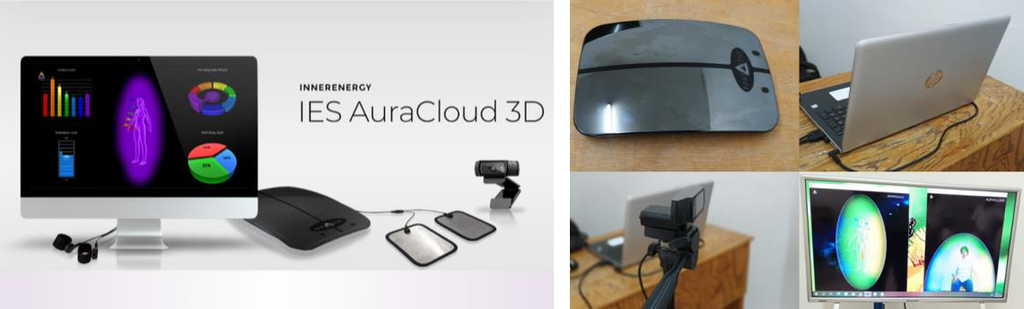
The equipment used for this purpose was an IES Aura Cloud 3D multimedia biofeedback system, AuraCloud Suite, InnerEnergy, from Inneractive Enterprises, Inc.
What Is Biofeedback?
Biofeedback is a group of therapeutic procedures that uses electronic or electromechanical devices to accurately measure, process, and provide feedback on information about a person’s activity through analog or binary, auditory and/or visual feedback signals.
The objectives are to help people develop greater awareness and voluntary control over physiological processes that would otherwise be outside conscious awareness or under less voluntary control.
The technology is the correlation between measured biofeedback data and specific emotional and energetic states of a person.
During the biofeedback session, the person being studied sat in a comfortable wooden chair and was connected to the biofeedback instrument through sensors attached to the surface of the skin of the hand.
The electrical impulses from these locations were recorded and displayed on a computer monitor in the form of graphs or other visual presentations.
Interactive biofeedback technology is based on research and scientific principles initiated by the following experts:
- Research by Dr. Valerie Hunt and Thelma Moss at UCLA Los Angeles in the 1970s.
- Dr. Schwartz and Biofeedback research.
- General research on biofeedback, especially EDA, temperature, brain waves, etc.
Although the results of the biofeedback test provide a wide variety of data, for the purposes of this study the auric changes occurring before and during an in-person or distance initiation were basically considered.
Some of the relevant individual results of the participants are also included in the report of some of the initiations carried out.
Study Data and Reports
The first work carried out involved in-person and distance initiation — at a distance in meters —, whose results in images are as follows.
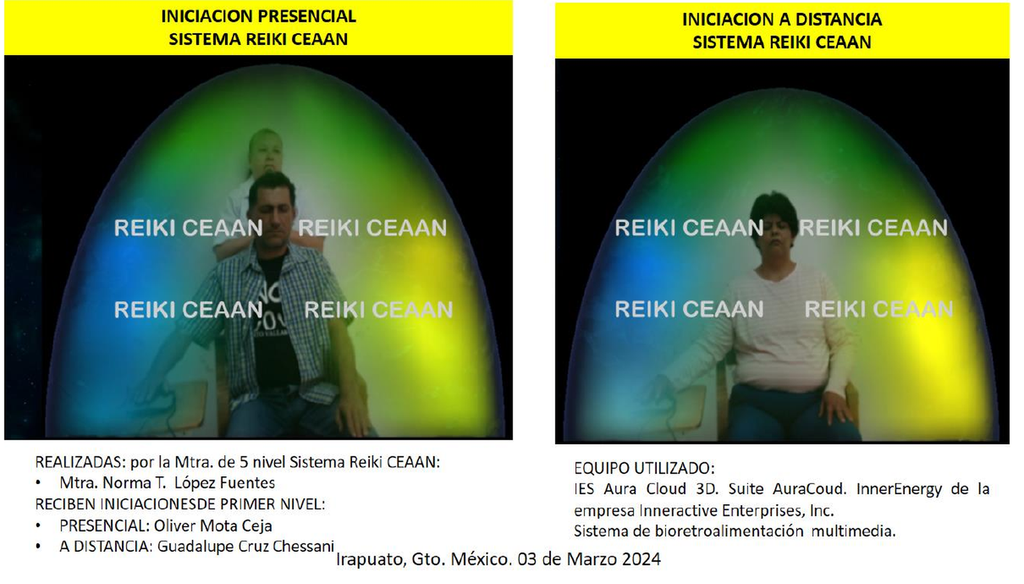
As can be observed, the auric energetic results of the initiation process in participants in one type of initiation and the other — in-person and distance initiation of the same degree and the same system — are similar in terms of the color of the aura at the end of the initiation, which demonstrates that, in either case, the initiation can be considered adequate.
We must observe that the auric fields of initiated persons are different when their own auric fields are observed without the initiation process and when they undergo the same process, whether the initiation is in-person or at a distance.
To validate the corresponding results regarding distance initiation, because they were performed by the same person and in a common space, although with the difference in range required for the case of distance initiation, three distance initiations were subsequently carried out with different masters, from different countries: Chile and Argentina; and using different techniques: Reiki CEAAN, Reiki Okuna, and Reiki Usui.
The first of these was again performed on Guadalupe Cruz Chessani, from Santiago de Chile; first-level distance initiation for comparative purposes.
On this second occasion, the graph produced by the biofeedback equipment regarding the flow of energies in people in terms of body-mind-spirit was used.
The results near the climax of the initiation were as follows:
At the same time, her crown chakra was in energetic expansion in relation to the other energy wheels.
As can be observed in the first initiations and later in the one again performed on Guadalupe Cruz Chessani from Santiago de Chile, the aura presents the same colors as the distance initiation performed previously.
Subsequently, a first-level Reiki Usui distance initiation was carried out from Santiago de Chile, also performed by Master Nicolás Benedetti Ariza, as an exception to the research.
The colors shown by the person’s aura are very similar to those of Reiki CEAAN observed previously.
In addition, we observe an expansion in the energy of her chakras, especially in the crown chakra.
At the moment of the climax of the initiation, the initiated person increases their spiritual energy in contrast to their mental and bodily energy; as well as the energetic concentration of the seventh chakra.
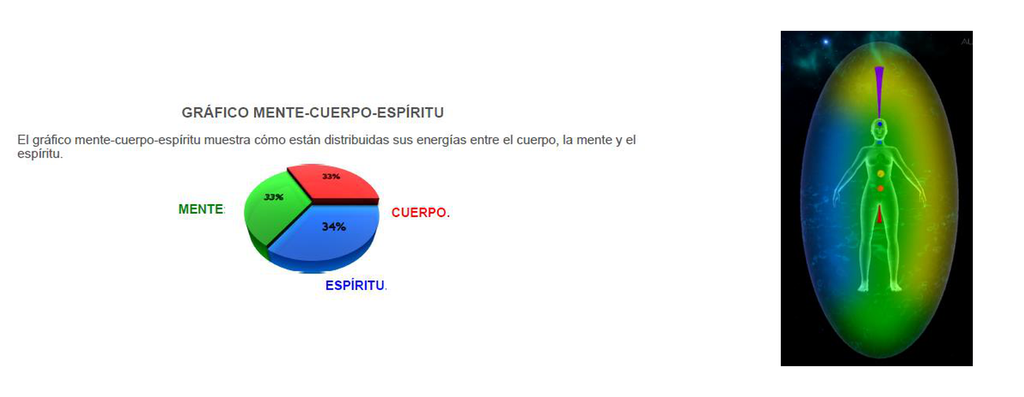
This demonstrates that the aura colors of the people studied in distance initiation show similar auric activity.
It should be noted that the distance initiation procedures of the Reiki CEAAN system are analogous to the initiations of the Reiki Usui System; therefore, the auric manifestation in initiated persons reflects analogous colors.
It is specified that the procedures and techniques are analogous and NOT homologous.
Analogous: they may adopt a similar appearance by fulfilling a certain function, but they are not the same; homologous.
A highly relevant aspect is that the Reiki Usui initiation performed by Master Nicolás Benedetti was an exception to the research.
Reiki Okuna/Atlante
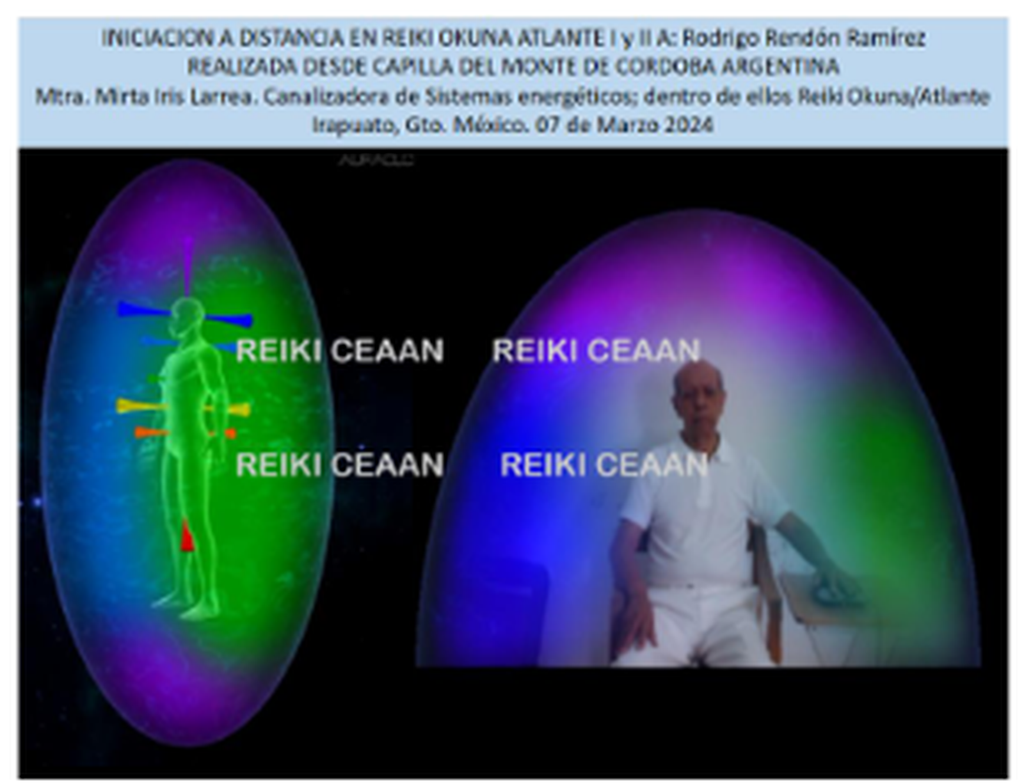
Another study carried out in relation to distance initiation was performed from Argentina by Master Mirta Iris Larrea, using the Reiki Okuna/Atlante system; Reiki channeled by her, which does allow distance initiations.
Reiki Okuna shows, through the sensors of the biofeedback equipment, in the initiation of grades I and II, colors different from Reiki CEAAN and Reiki Usui; therefore, there are at least two possibilities:
- The initiation procedure is completely different from the two systems mentioned above.
- Since two levels were initiated at the same time — I and II — this may have modified the manifested color of the energy in the auric field.
However, a concentration of energy is generated in the person’s chakras 3, 6, and 7.
To conclude the research carried out, a third-level Reiki Usui distance initiation was performed, also from Santiago de Chile, by Master Nicolás Benedetti Ariza, as an exception to the research.
What These First Records Show
The data presented in this part correspond to the first observations made within the research.
The study records in-person and distance processes, different masters, different locations, and different Reiki systems.
The observations include similarities in some processes and differences in others.
In particular, the author records similarities in the auric colors observed in certain distance initiations of Reiki CEAAN and Reiki Usui, while the Reiki Okuna/Atlante case presents different characteristics.
The study itself proposes possible explanations for these differences, without establishing a single definitive interpretation.
Because this is exploratory research, these records form part of an observation process that may subsequently allow new lines of research and verification.
What Comes Next
The methodology makes it possible to understand how the first observations were carried out.
Now, based on these records, a new question arises:
What results can be identified when comparing the different experiences, and what limitations should be considered in their interpretation?
This will be the question addressed in the next part of the research.
About the Author
Alfredo Aguilera Saldaña is a retired administrator and academic from the University of Guanajuato, Mexico. He is President of Alianza Reiki de México A.C., founder and former Secretary of the Federación Iberoamericana de Reiki A.C., and founder of the Reiki CEAAN System.
His trajectory brings together Reiki, education, research, human development, and literature.
Learn more about Alfredo Aguilera Saldaña and his work at Mundo Reiki:
Alfredo Aguilera Saldaña — Author Page
Previous Articles
Reiki Initiation: Between Tradition and New Paths of Teaching
Editorial Note
Part 3 of 4 — This article is part of Alfredo Aguilera Saldaña’s research work on Reiki initiation.
This article was prepared from The Initiation of Reiki from a Perspective of Objective Exploratory Non-Conclusive Research with a Multimedia Biofeedback Device, especially pages 22 to 31, corresponding to the methodology and the first data and reports of the study.
Mundo Reiki maintains the exploratory and non-conclusive character attributed by the author himself to the research. The data and observations presented correspond to the original document.