Children Difficult or Overloaded Childhoods?
Reflections on Technological Childhood
I have been thinking a lot about the children we call “difficult.”
The child who cannot stop. Who does not know how to wait. Who becomes irritated easily. Who abandons a game only a few minutes after starting it. Who seems bored with everything. Who does not accept a “no.” Who needs something to be happening all the time.
And the more I observe contemporary childhood, the more one question stays with me:
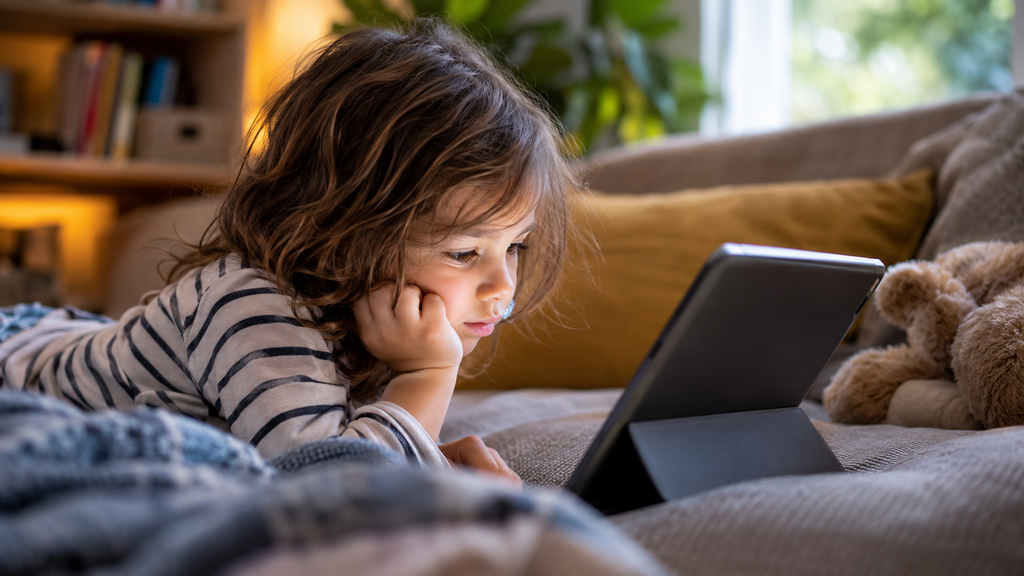
Are we facing difficult children or overloaded childhoods?
Technology is part of childhood today. I do not believe it is possible — or necessary — to imagine a childhood completely distant from it.
What concerns me is excess.
And not only because of the number of hours a child spends in front of a screen, but because of what those hours begin to replace.
When a screen occupies a large part of everyday life, it can also occupy the time for movement, conversation, spontaneous play, contact with other children, nature, rest, and even boredom.
Waiting has gained a screen.
The journey has gained a screen.
The meal has gained a screen.
Boredom has gained a screen.
Sometimes, even crying and frustration gain a screen.
And there is another issue that concerns me: the intensity of the stimuli.
Short videos, rapid scene changes, sounds, images, games, immediate rewards, and content that follows one another almost without interruption offer an experience very different from the rhythm of everyday life.
After so much speed, the real world can seem too slow.
Waiting takes too long.
A simple game quickly loses its appeal.
Silence becomes uncomfortable.
Boredom seems unbearable.
And the child begins constantly looking for the next stimulus.
When Part of Childhood Becomes Something to Watch
At the same time, part of the childhood experience itself is changing.
The child does not only play: they watch other children playing.
They do not only play games: they watch gameplays.
They do not only invent stories: they receive stories, images, movements, and endings produced by someone else.
Little by little, part of childhood risks no longer being experienced, but watched.

And the body may also begin to speak.
Difficulty slowing down, irritability, disorganized sleep, agitation, tiredness, and intense reactions when the screen is taken away should not be viewed in isolation or automatically turned into diagnoses.
But they should not be ignored either.
Because perhaps we are looking too much at the child’s behavior and too little at the environment we have built around them.
I do not believe screens explain all childhood behavior. Children are different, they live different stories, and there are countless reasons for a change in behavior.
But I also cannot ignore a contradiction of our time:
We want children who are capable of self-regulation while offering them a daily life increasingly regulated by external stimuli.
Self-regulation does not come ready-made.
Little by little, children learn to wait, desire, become frustrated, reorganize themselves, notice their own bodies, move through boredom, and discover what to do when nobody immediately gives them something to consume.
To learn all of this, they need the opportunity to experience all of this.
Before Asking What Is Wrong with the Child
That is why, before asking “what is wrong with this child?”, I have preferred to ask other questions:
- How much screen time is there in their days?
- How much free movement?
- How much unstructured play?
- How much contact with other children?
- How much rest?
- How much silence?
- How much time is there simply to be?
Perhaps we are trying to teach children to slow down after building a world for them that almost never slows down.
Perhaps we are concerned that they do not know how to wait after eliminating almost every opportunity to wait.
Perhaps we are concerned that they do not know how to deal with boredom after filling every empty space.
And perhaps some of the behaviors we now classify as “difficult” are also forcing us to look at what we, as adults, have normalized.
Because discussing excessive screen use does not mean being against technology.
It means asking what happens when technology stops occupying a place in childhood and begins to occupy the place of other childhood experiences.
Before asking why a child cannot stop, perhaps we need to ask:

When was the last time the world around that child really stopped?
Childhood needs stimulation.
But it also needs pauses.
It needs movement, connection, imagination, silence, boredom, play, and time.
Time not only to watch childhood happen.
Time to live it.
About the Author
Vanessa Lima Nunes is a pedagogue, literacy educator, specialist in Childhood Cultures, and neuropsychopedagogue. She works in Education and dedicates her work to understanding childhood, learning, and the different ways in which children express themselves and develop.
Throughout her career, she has developed an attentive perspective toward what children communicate not only through words, but also through the body, behavior, play, silence, drawing, music, and other forms of expression.