Reiki Without Hurry, Without Promises, and Without the Need to Be Special
“How am I living what I say I believe in?”
There is a question that, for me, is worth more than many explanations about Reiki: “How am I living what I say I believe in?”
It is a simple and perhaps even uncomfortable question, because it takes us away from the place where it is easy to talk about consciousness, energy, spirituality, or transformation and places us face to face with concrete life. With the way we wake up, the way we treat our bodies, the way we respond to difficulties, the attention we give to the people who are with us, and our ability to stop before reacting.
The more I study Reiki, the less interested I am in a spirituality built around titles, phenomena, and extraordinary experiences. I am increasingly interested in a spirituality that can be lived in everyday life, in our daily choices, and in the way we move through whatever life brings us.
“Reiki does not need to make us special. Perhaps it does exactly the opposite and brings us back to simplicity and to life as it is.”
Reiki and Our Hurry
Many people approach Reiki looking for a quick answer, hoping to perceive immediately during a session that something has changed. They want to relieve a symptom, solve a difficulty, find a technique for anxiety, or discover the right symbol for a particular situation.
It is understandable, because we live in a culture that teaches us to look for solutions to everything. If there is a problem, there must be a technique. If there is discomfort, there must be a way to eliminate it. If there is a difficulty, we expect to find a formula capable of quickly giving us back control.
Even when we approach spirituality, we bring this need for effectiveness with us, and we want to feel that we have been chosen, that we have an extraordinary mission, or that we possess a special ability.
But Reiki can be deeply unsettling when we realize that it does not necessarily respond to this expectation. It does not need to promise that life will obey our wishes, nor turn every difficulty into a beautiful message.
Nor should it be presented as a substitute for medical, psychological, or any other health care we may need. A Reiki practice can be integrated into a perspective of well-being, but it should be practiced responsibly, without promises of healing and without leading anyone to abandon appropriate care.
Before the Technique, There Is the Person
It is very easy to turn Reiki into a collection of techniques. One hand position for this, a symbol for that, a sequence for a particular discomfort, or a specific practice to unblock some area of life.
Knowing techniques can be useful because they provide structure, help those who are beginning, and allow us to develop a more conscious and consistent practice. But there is a risk when we begin to believe that a technique, by itself, can solve everything.
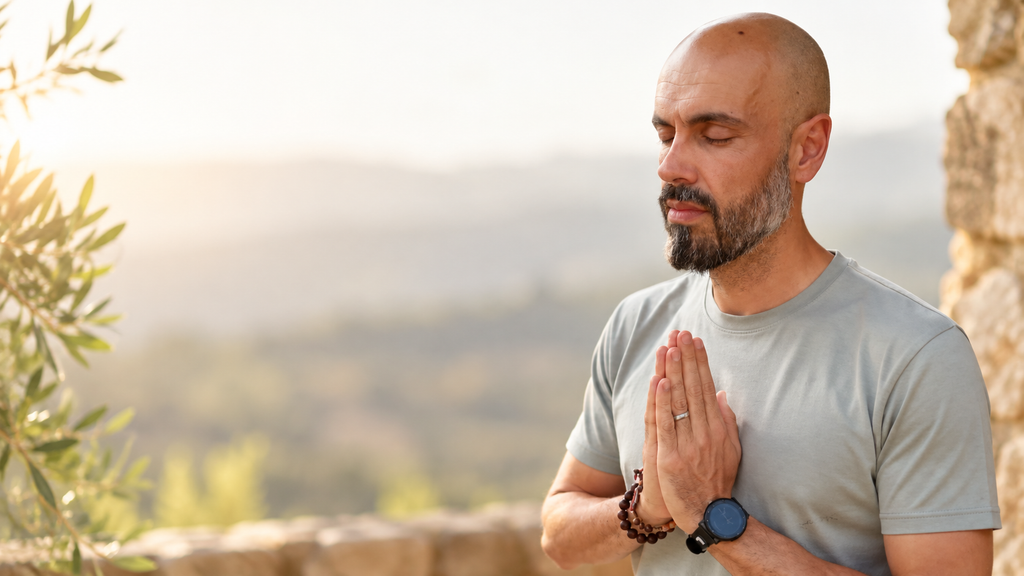
Before the technique, there is the person. There is someone who is tired, who has become accustomed to ignoring the body’s signals, who lives worried and constantly anticipating what might go wrong, or who has become so efficient at taking care of others that they no longer really know how to take care of themselves.
If there is no capacity to be present in the moment, the technique can become just another task.
Therefore, many times, the most important question is not “what is the right technique?”, but “can I really be here while I practice?” Can I notice what is happening without immediately trying to change everything? Can I listen to my body without forcing it to give me an answer?
This change may seem small, but it profoundly alters our relationship with the practice.

“Before the technique, there is the person.”
About the Author
Justino Pereira lives in Vila de Rei, in the interior of Portugal. He is a Reiki practitioner, therapist, and Reiki Master, as well as the founder of Vila de Reiki, a project that seeks to offer a serene and integrated space for the practice, teaching, and communication of Reiki.
His main professional career was as a prison officer, where he spent more than a decade working in a prison environment. This time deeply marked him, bringing him face to face with questions of dignity, suffering, and the possibility of human transformation. It was also during this period that he became self-taught in the field of personal development and began exploring esoteric and spiritual paths, seeking to understand what lies within us and how this relates to the way we are in the world.
Meet Justino Pereira and all his articles →