Reiki Beyond the Hands: When Practice Becomes a Way of Life
Michele Nunes Scheidt
Integrative Therapist, Reiki Usui Traditional and Karuna Reiki Master, and writer.
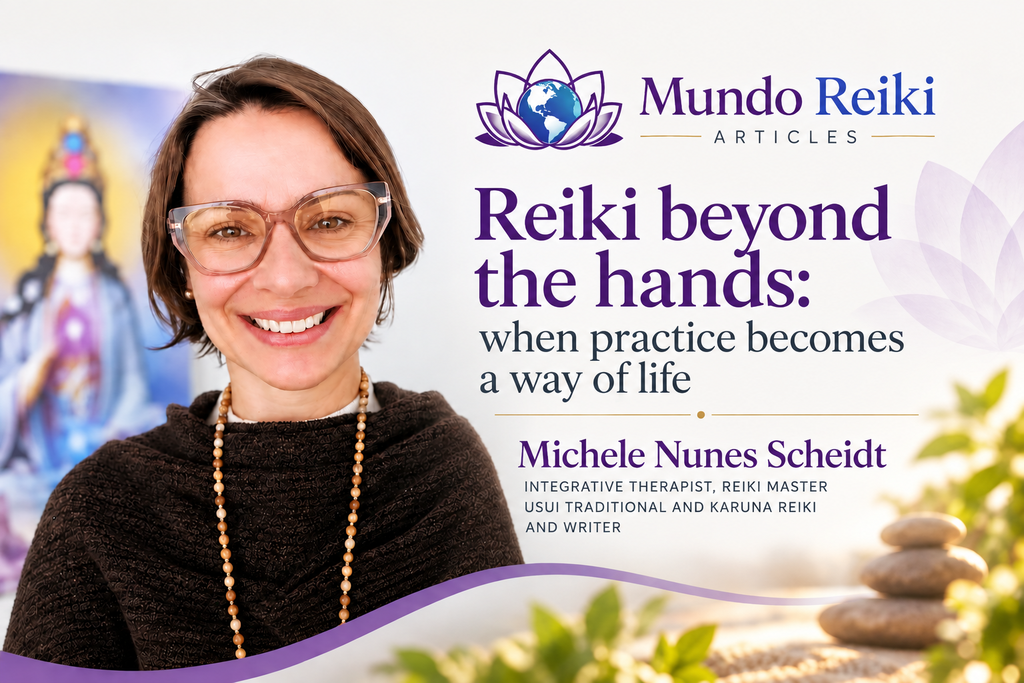
“The protocol taught me where to place my hands. The years of practice began to teach me where to place my awareness.”
When I First Discovered Reiki
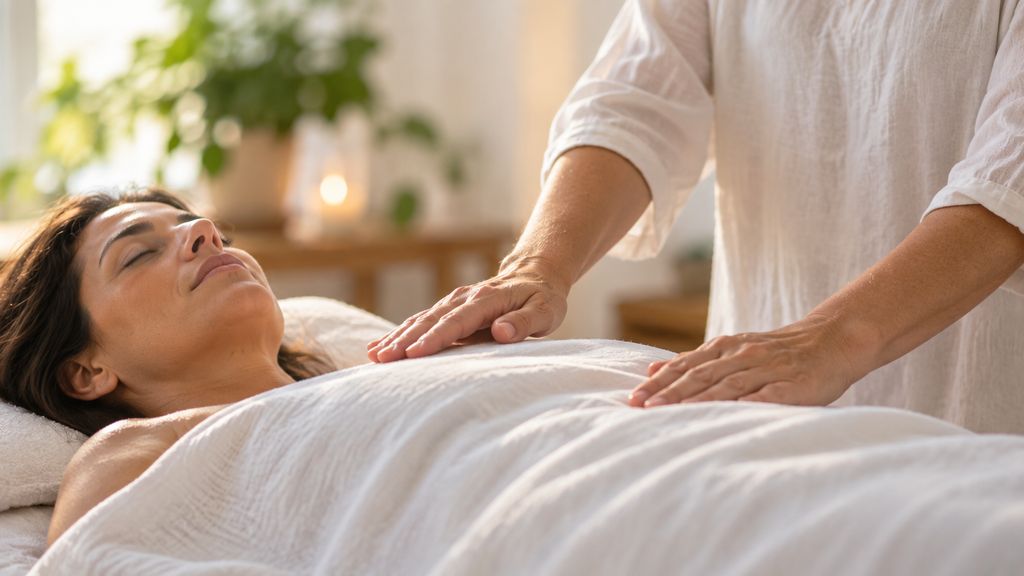
When I first discovered Reiki in 2001, I learned as many Reiki practitioners did at that time: by following a sequence of hand positions. There was a protocol to follow, a specific amount of time to remain in each position, and an established way of carrying out the practice.
I was not taught to feel. I was not taught to perceive what was happening beneath my hands or to develop a more sensitive form of listening during an application. I learned the positions, became familiar with the Five Reiki Principles, and that was how I began.
And there is nothing wrong with that.
When we take our first steps on any path, we need references. The protocol provides security, organization, and a structure for practice. It was important to me and became part of the foundation of the Reiki practitioner I became.
When Practice Becomes Study
But the years passed. Practice became study, study brought new questions, and those questions made me return many times to what Mikao Usui had left as a foundation.
Little by little, I began to understand that Reiki was not only what happened while my hands remained over certain parts of the body. There was something much greater being taught.
As I deepened my studies, I discovered other ways of understanding and practicing Reiki. I learned about perception, presence, listening, and the possibility of allowing the hands to also be guided by what we perceive during a practice.
I discovered that I did not simply have to follow a sequence. It was possible to stop, perceive, feel.
“I discovered that I did not simply have to follow a sequence. It was possible to stop, perceive, feel.”
And this profoundly changed my relationship with Reiki.
Feeling Is Also Being Present
Feeling, however, does not mean abandoning technique or turning every perception into an interpretation. Much less diagnosing what is happening to the person receiving Reiki. Feeling means being present. It means becoming quiet enough to perceive. It means understanding that there is a difference between simply placing the hands and being truly present with them.
Over time, I realized that this listening did not happen only during an application. The more I learned to feel with my hands, the more I was invited to perceive myself.
The Five Reiki Principles
And it was also in this way that the Five Reiki Principles began to take on another dimension in my practice.
When I first discovered Reiki, I learned the principles in a translation closer to their literal form:
- Just for today, do not be angry.
- Just for today, do not worry.
- Be grateful to all beings.
- Work honestly.
- Be kind to all beings.
At that moment, they came to me as part of the teachings of Reiki. Years later, I discovered a therapeutic and affirmative way of working with these same principles and chose to incorporate it into my personal practice:
- Just for today, I am calm.
- Just for today, I trust.
- Just for today, I am grateful.
- Just for today, I work honestly.
- Just for today, I am kind.
For me, it is not a matter of choosing one form over the other. The first preserves closeness to the teaching that was transmitted to us; the second invites me to experience it in an affirmative way, bringing into the present what I wish to cultivate within myself.
When the Principles Enter Life
And perhaps it was precisely there that the principles began to leave the page and truly enter my life.
Because calm, trust, gratitude, honesty, and kindness take on another meaning when they stop being words we repeat and begin to guide the way we move through everyday experiences — especially those that challenge us.
Calm is put to the test when something goes against us. Trust, when we do not have all the answers. Gratitude deepens when we learn to recognize what difficult experiences also have to teach us. Honesty appears in the coherence between what we believe and the way we live. And kindness perhaps reveals its most challenging side when we understand that it needs to reach not only others, but ourselves as well.
“Perhaps it was precisely there that the principles began to leave the page and truly enter my life.”
That was how the Five Principles ceased to be, for me, something simply to know or recite and became part of a daily practice of self-knowledge.

Doing Reiki and Living Reiki
At first, my attention was very much focused on doing Reiki. Over time, I began to understand what it meant to live Reiki.
“Because the practice does not end when we finish an application.”
It continues in the way we respond to a difficult situation, in the way we treat someone, in what we do when no one is watching, in our ability to recognize our own emotions before projecting them onto another person, and in the daily choice to be kinder to ourselves and to all beings.
It is in this sense that I now understand Reiki as something much more than the hands.
The hands, the techniques, and study remain important. Tradition continues to be the root that sustains the path. But at some point, all of this needs to find a place within us.
Where to Place Awareness
The protocol taught me where to place my hands. The years of practice began to teach me where to place my awareness.
And perhaps there is great wisdom precisely in the words that precede each of the principles: Just for today.
There is no demand for perfection there. There is an invitation to presence.
“We have today to observe, choose, and begin again.”

A Path That Continues
After so many years on this path, I continue learning, practicing, and finding new questions and new meanings in the same principles.
Perhaps this is one of the greatest beauties of Reiki: the further we walk, the more we realize that there is still so much to learn.
And perhaps it is precisely through this movement that, little by little, we stop simply doing Reiki and truly begin to live it.
Michele Nunes Scheidt
Integrative Therapist, Reiki Usui Traditional and Karuna Reiki Master, and writer.
About the Author
Michele Nunes Scheidt began her journey with Reiki in 2001 and, since 2012, has dedicated herself fully to teaching, clinical practice, and the development of projects focused on holistic care through this therapy.
A writer and researcher dedicated to deepening the philosophy and practice of Reiki, she shares her knowledge through courses, experiential practices, mentoring, lectures, and publications, contributing to the education of Reiki practitioners and masters.
Previous Article
This article continues the journey previously presented by Michele Nunes Scheidt on Mundo Reiki.
Michele Nunes Scheidt: Teaching, Research, and Dedication to Reiki
Michele Nunes Scheidt: Teaching, Research, and Dedication to Reiki
In the previous article, Michele presents her journey through Reiki teaching, research, and practice. In this new reflection, she goes deeper into her personal experience and shares how, over the years, the practice gradually became more than a sequence of techniques, becoming also a path of presence, self-knowledge, and everyday life.