The Power of Pretend Play as a Path to Recognizing and Regulating Children’s Emotions
“Many times, what the child is not yet able to say, they are able to express through play.”
Before learning to regulate, it is necessary to recognize
I believe that, before learning to regulate emotions, a child first needs to know them.
They need to learn to perceive what they feel, recognize different emotions, find words to name them, and understand that feeling is part of the human experience.
It is from this perspective that I see pretend play as a powerful possibility for emotional recognition and regulation in childhood.
For me, pretend play is not just a game.
It is a language of its own for children.
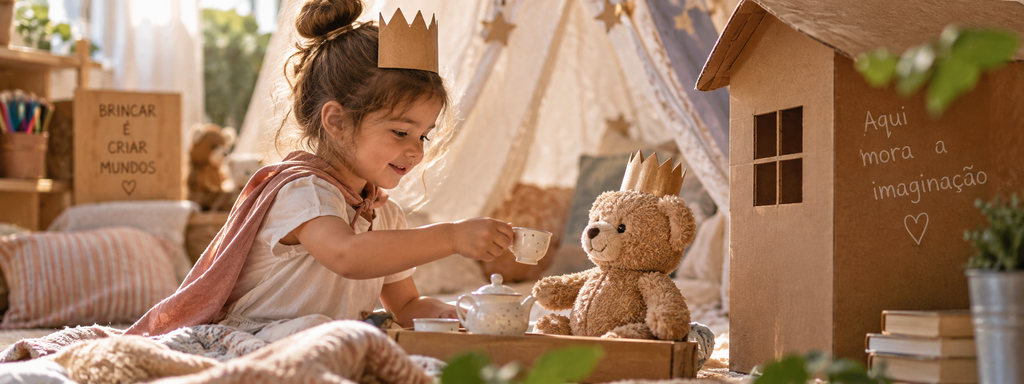
When children play, they also express themselves
When a child plays house, school, doctor, family, animals, or imaginary characters, they are creating a symbolic space where they can represent situations, experiment with roles, and express feelings that they are not always able to communicate directly.
Many times, what the child is not yet able to say, they are able to express through play.
- A doll can feel afraid.
- A character can become angry.
- A teddy bear can be sad.
And when the child places these emotions into the character, they also create a certain distance that can make it easier to talk about what they are feeling.
The adult as a mediator
This is when I can step in as a mediator.
Instead of asking directly:
“Why are you angry?”
I can ask:
“What happened to this character?”
And, many times, the answer comes through play.
For this reason, I understand pretend play as a possibility for an integrative and spontaneous practice of childhood, because it brings together:
- imagination;
- body;
- language;
- affection;
- connection;
- symbolization.
Preserving the freedom to play
I do not want to turn play into a rigid or constantly directed activity.
I want to preserve what is most precious about play: the child’s freedom to create, imagine, experiment, and express themselves.
My role is to observe.
To listen.
To welcome.
To name emotions when necessary.
And to offer possibilities.
- Not interpret everything.
- Not correct everything.
- Not direct everything.
- But be present for whatever emerges.
Recognizing in order to be able to deal with emotions
I believe that emotional regulation does not begin when we teach a child to control what they feel.
It begins when we help that child recognize:
“What I am feeling exists. It has a name. I can talk about it. I can understand it. And I can find ways to deal with it.”
That is why I see pretend play as such a meaningful path.
Because, while playing, children are often saying, through their characters:
“Look at what I still do not know how to explain.”
And perhaps this is precisely where truly respectful emotional education begins:
not by teaching children to stop feeling, but by helping them understand what they feel so that, little by little, they can discover what they can do with it.
About the Author
Vanessa Lima Nunes is a pedagogue, literacy educator, specialist in Childhood Cultures, and neuropsychopedagogue. She works in Education and dedicates her work to observing and understanding the different processes of learning and development in childhood.
She is also a practitioner of Radionic Tables, a reader, a curious person, and a researcher of integrative therapies. Her experience as an educator informs a writing style marked by the observation of everyday life, reflections on childhood, and an interest in understanding different forms of expression, learning, and care.
As a contributor to the Mundo Reiki Library, Vanessa shares her experiences and reflections on childhood, education, presence, and integral care.
📍 Pelotas – Rio Grande do Sul, Brazil
Read also
Childhood Needs Time to Exist
Learn more about the author
Vanessa Lima Nunes
The Playground as an Integrative Therapeutic Space for Childhood