Before the Technique, There Is a Person
By Gutta | Um Novo Caminho
I have been thinking a lot about the therapist’s place when facing a person who comes for care.
Why is it that, so often, when a therapist receives a complaint, the first thought is immediately about which technique to use?
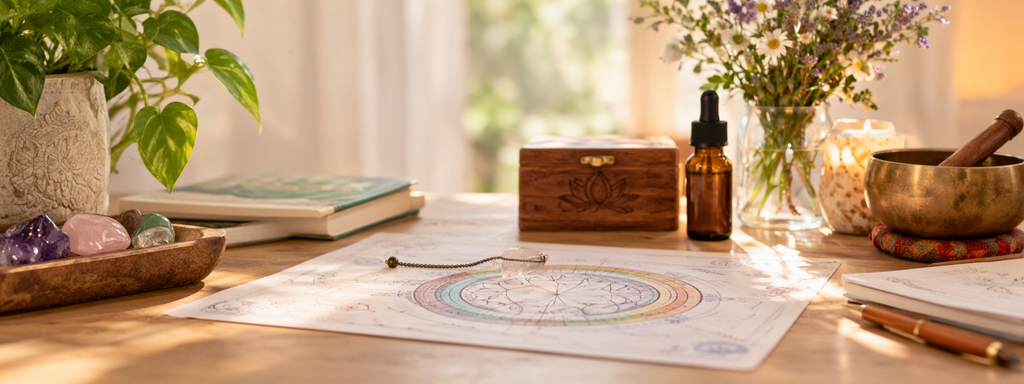
Table, pendulum, protocol, method.
But before all of that, there is a person.
“Why does the therapist just want to open the table and that’s it? Isn’t there supposed to be a good interview first?”
This question reflects a great deal of how I understand therapeutic care.
I like to sit down, listen to the story, and understand everything connected to the complaint being presented.
Because a complaint can have many layers.

Listening Before Applying
For me, technique cannot replace listening.
“Applying the technique alone does not deepen the layers.”
Before choosing what to do, we need to understand who is in front of us.
The therapist needs to know how to listen, ask questions, observe, and perceive what lies beyond the first manifestation.
And this deeper understanding does not have to happen in a single session.
“It doesn’t have to happen in just one session.”
A therapeutic process can be built over time. What matters is that the therapist knows how to guide that process, recognizing what has emerged, what can be explored further, and what the next step might be.
When the Therapist Gets Stuck
I have noticed that many therapists do not get stuck because they lack tools.
Sometimes, they get stuck precisely because they have too many tools, but have not yet developed the confidence to understand what to do when faced with a real person, with a real story.
“The therapist who gets stuck when it comes to attending to the client.”
This blockage can appear in different ways.
Because they do not know what the next step will be.
Because they think they need to say something simply because it worked with someone else.
Because they do not have enough knowledge to understand emotional or mental aspects, or everyday situations.
Or because they end up looking at the client through the lens of their own family history.
“They don’t connect it to the complaint because of their insecurities… because they don’t know the next step, because they think they should say this because it happened the same way to them or to someone else, because they don’t have enough knowledge about emotional or mental aspects, everyday situations, or because they were raised that way and rely on their family history. There are many layers.”
That is why I believe the therapist also needs to learn how to look at themselves.
The Therapist Needs Their Own Perspective
I do not believe that all therapists need to work in the same way.
Each professional can develop their own way of working.
But there is a difference between having your own way and simply doing what you learned somewhere.
“You can have your own way of working, but you need to have ownership and be able to stand behind what you say and do…”
For me, that ownership comes from awareness.
The therapist needs to know why they are doing something, recognize their own limits, and understand when they need to go deeper, study further, or seek another perspective.
We also have cognitive limitations.
We do not know everything. We do not perceive everything.
And recognizing this does not diminish the therapist. On the contrary, it can make them more responsible toward the person seeking their care.
The Tool Cannot Become the Therapist
I have also seen therapists place the tool in a position of absolute power.
“There are many therapists who are idolized, who think they can perform miracles with a pendulum.”
Or who believe that a table, a protocol, or any other resource will be enough to explain everything that happens to a person.
But we need to understand this so that we do not become entangled in it.
“We need to understand so we don’t become entangled.”
A tool can be an important resource within a practice. But it cannot replace the therapist’s perspective, listening, and responsibility.
Treating the Person, Not Just the Symptom
I am a flower essence therapist, and this experience is also part of the way I understand care.
“I am a flower essence therapist, and Bach treated the person. The symptom can change… because we are not treating the being.”
This sentence summarizes a concern that I consider essential.
The symptom may change.
Therefore, when we look only at what appears on the surface, we may fail to perceive the person behind that manifestation.
This does not mean that we need to solve everything immediately.
It means that we need to be available to understand.
The Therapist Also Needs to Learn How to Guide
Many therapists have knowledge, have taken courses, and have learned techniques, but still do not know exactly how to conduct a session.
And this is where I like to contribute.
- How do you receive this client?
- How do you establish a relationship?
- How do you listen?
- How do you investigate?
- How do you understand the different layers?
- How do you know what the next step might be?
- How do you develop confidence without losing humility?
These are questions that are part of this journey.
I do not believe in training that turns all therapists into the same kind of professional.
I want to contribute so that each professional can develop their own way of working, with greater awareness, presence, and confidence in what they do.
Awakening Awareness
There is also something that runs through all of this work: the awakening of awareness.
I like to motivate, bring presence, and strengthen the person who is in front of me.
My student, my client, my friend — each person arrives with a different story and at a different moment in life.
And today I have realized that therapists also come to me because they want to hear my perspective:
“Gutta, I need your perspective on how to work with something my client has brought up.”
This made me realize that there is something I can also offer to those who care for others.
Not to teach therapists how to make money.
Not to create formulas.
Not to turn a technique into an answer for everything.
But to help the therapist see more clearly.
A Space for Those Who Care
My focus is mainly on beginning therapists and those who are still developing their own way of working.
Therapists who have studied and learned techniques, but sometimes feel insecure when faced with a real session.
This is the therapist I want to contribute to.
Not by teaching a ready-made formula, but by developing therapeutic perspective, listening, presence, awareness, and the ability to guide a process.
- Not to teach the therapist how to make money.
- Not to create formulas.
- Not to turn a technique into an answer for everything.
- But to help the therapist see more clearly.
Perhaps this work could be understood as a kind of “therapy for therapists” — not as a substitute for each professional’s own therapeutic process, but as a space to look at their practice, difficulties, insecurities, and possibilities.
I want to help the therapist move from:
“What do I do now?”
to:
“What am I noticing here? What do I need to understand better? What is the next step?”
And, above all, to help them find their own way of working, with confidence, awareness, and responsibility.

A Path for Those Who Care
Perhaps this is the place I am beginning to recognize in my own work.
To contribute to therapists so they can develop their own perspective, their listening, and their way of guiding a session.
Especially those who are beginning and who, even with knowledge and tools, still ask themselves:
“And now, what do I do with this client?”
I do not want to offer ready-made answers.
I want to help build better questions.
I want the therapist to be able to look beyond the technique, recognize the layers within a complaint, perceive their own limits, and find ways forward with greater presence and awareness.
Because every therapist can have their own way of working.
And every person who comes to them deserves to be listened to as a unique individual.
Perhaps my mission is precisely there:
“A traveler who has learned to guide.”
To help those who care for others learn how to look.
And to continue walking alongside those who have also chosen this path of care.