Wild Rose: A Woman’s Cycles and the Blossoming of Wisdom During Perimenopause and Menopause
Author: Letícia Giovelli · Bach Flower Remedies · Menopause and Holistic Health
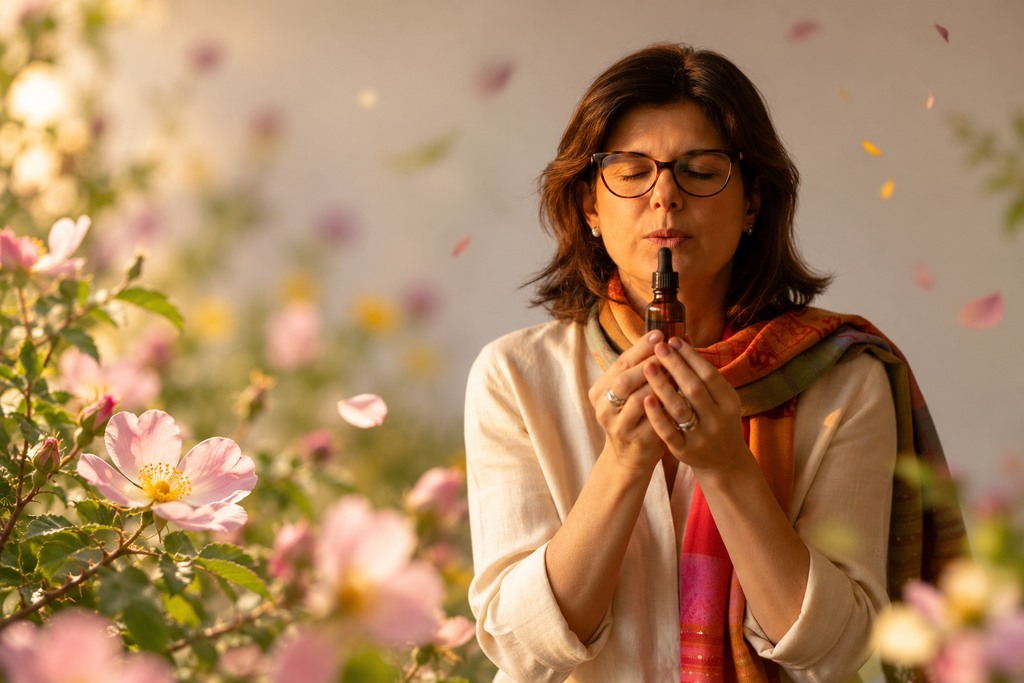
There are moments in life when we do not need more strength to keep doing the same things. We need to rediscover the meaning of moving forward.
Nature teaches us that every cycle has its own beauty. Spring blooms, summer expands, autumn transforms, and winter invites us to turn inward. No season needs to last forever for life to keep flowing.
It is the same for women.
There is a time for discovery, a time for building, a time for caring, nurturing, creating, and sustaining. For many years, feminine energy may be directed outward: toward children, family, work, relationships, and the many responsibilities that weave together the fabric of life.
But a moment comes when these cycles begin to change.
The climacteric marks this transition. The body changes, menstruation becomes irregular until it eventually ceases, and a woman may sense that something beyond physiology is also calling for change. Not every woman experiences this stage in the same way. For some, it comes with physical and emotional discomfort; for others, it also brings an unexpected desire to reassess choices, reconnect with personal desires, and discover new possibilities.
This transition can bring us face to face with important questions: What still feels meaningful to me? What do I keep doing out of habit? Where is my vitality? What do I want to cultivate in the years ahead?
It is within this landscape of transformation that we can find a valuable reflection inspired by Wild Rose, one of the flower remedies in the Bach Flower system.
Wild Rose: When Life Loses Some of Its Color
In Edward Bach’s original description, Wild Rose is associated with resignation, apathy, and the attitude of someone who has stopped striving for change, accepting life as it is, even when it no longer brings much enthusiasm.
This is not simply about feeling tired, needing rest, or wanting a quieter life. There is a difference between respecting our own pace and silently giving up on participating in our own existence.
Sometimes, a woman continues fulfilling her duties, working, caring for her family, and meeting expectations. On the outside, everything seems to be working. But inside, life gradually loses its color.
The days repeat themselves. Desires are postponed. Things that once sparked curiosity no longer inspire the same interest. A kind of resignation toward one’s own story may emerge: this is how things have been until now; perhaps this is how they will always be.
During the climacteric, this experience may coincide with significant changes. Children become more independent, parents grow older, professional life demands new arrangements, and relationships undergo transformations. A woman may realize that the roles that shaped much of her identity no longer occupy the same place in her life.
When attention has been directed toward other people’s needs for a long time, it can be difficult to recognize what still brings us joy.
Wild Rose invites us to look at this state without judgment. Not to demand enthusiasm, as though we had to be happy all the time, but to recognize where we have stopped wanting, choosing, and actively participating in our own lives.
The flower remedy is traditionally used as emotional support in states of resignation and apathy. It does not replace the assessment of persistent physical or emotional symptoms, but for those who choose this approach, it may form part of a process of self-awareness and care.
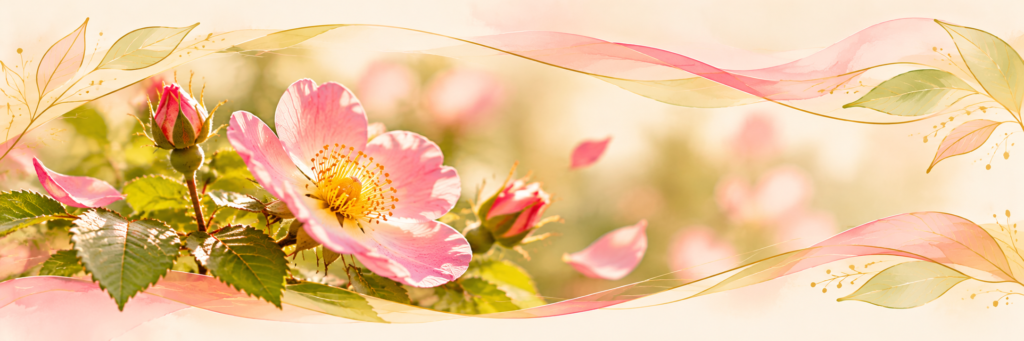
The Climacteric: A Transition, Not an Ending
For a long time, menopause was presented primarily as an ending: the end of fertility, menstrual cycles, and a particular stage of youth.
But a life cannot be reduced to the ability to have children, just as femininity cannot be limited to reproductive function.
A woman continues to embody her body, desires, creativity, intelligence, sensitivity, and potential. What may change is the way these dimensions express themselves.
Perhaps the climacteric is also an opportunity to look at our own stories through different eyes. Not to deny what we have lived, but to recognize what we have built, what has cost us too much, and what still deserves to blossom.
There are dreams that remained tucked away because work had to come first. There are desires that were postponed because someone needed care. There are parts of ourselves that learned to wait quietly for an opportunity that never seemed to arrive.
And now?
Perhaps we do not need to make every change at once. Sometimes, the first step is very small: reconnecting with a friend, going for a walk again, learning something new, allowing ourselves to rest without guilt, or discovering an interest that does not need to serve anyone but ourselves.
Vitality does not always return as a great passion. Sometimes, it begins as a quiet curiosity, a desire to leave the house, a conversation that sparks interest, or a morning when we feel like doing something different.
This is how life can regain its color: not through the obligation to blossom, but through the possibility of choosing again.
From Resignation to Wisdom
There is a difference between accepting life and resigning ourselves to it.
Acceptance means acknowledging reality so that we can find a possible way forward. Resignation, in the sense associated with Wild Rose, means no longer expecting that anything could be different.
The wisdom that can mature over time does not require a woman to remain strong, available, or enthusiastic at all times. It also grows from the ability to acknowledge losses, respect boundaries, let go of unrealistic expectations, and discover new forms of pleasure and fulfillment.
A mature woman does not need to prove that she is still young. Nor does she need to turn every difficulty into an opportunity for growth. She can feel sadness, exhaustion, ambivalence, and longing. She can grieve what has ended while also wishing for what she has not yet come to know.
Perhaps true transformation lies in no longer confusing the end of a cycle with the end of possibilities.
Wisdom does not consist of having all the answers. Often, it means asking more honest questions.
- What do I want to carry with me from this stage of life?
- What can I leave behind?
- Where do I want to place my energy now?
- What kind of life reflects the woman I have become?
Wild Rose offers us a symbolic image for this movement: moving away from passive acceptance and gradually reclaiming our participation in our own stories.
It is not about returning to who we once were. It is about discovering who we can become from here.
There Are Still Flowers Yet to Bloom
Nature does not ask a rosebush to produce flowers all year round. There are periods of expansion and periods of retreat. There are moments when energy gathers in the roots, preparing what cannot yet be seen.
Perhaps women, too, need to recognize this wisdom of cycles.
Not every pause is giving up. Not every change needs to happen quickly. But when life loses its color for a long time, it deserves to be heard with kindness and attention.
The climacteric can be an invitation to reconsider our relationship with the body, time, relationships, and our own desires. Not as a promise of effortless transformation, but as an opportunity to build a stage of life that is more conscious and more aligned with who we are today.
Within the philosophy of Bach Flower Remedies, Wild Rose reminds us that life can become interesting again when we stop merely moving through it and begin participating in it once more.
Perhaps the woman who emerges from this transition is no less intense, loving, or vital. Perhaps she is a woman who no longer needs to blossom to be admired or sacrifice herself to feel needed.
A woman who knows her seasons better. Who recognizes the beauty of what she has lived and no longer gives the past the right to determine her entire future.
Because growing older does not mean ceasing to blossom.
It means discovering that there are many ways to do so.
And that even when some flowers have completed their cycle, living roots remain, seeds are waiting, and new possibilities are ready for their time.
About the Author
Letícia Giovelli — Integrative Psychotherapy
Caring for the soul is a journey… and I walk alongside you.
I have been a psychotherapist since 1995, passionate about understanding the human soul in its many layers—from silent pain to the deepest transformations.
In 2008, I broadened this perspective through flower essence therapy, becoming a Bach Flower therapist and later training in the Saint Germain and California flower essence systems. These subtle approaches explore emotions and personal stories while opening space for new possibilities of healing.
In 2022 and 2025, I had special experiences in England through field training in the Bach system—an opportunity to connect directly with the essence of the flowers and the philosophy that supports this deeply transformative work.
Throughout my career, I have integrated other approaches that expand awareness and our understanding of life, including Family Constellations and Pathwork.
I am a founding partner of Espaço Curarte, a space created to welcome, care for, and support transformation. There, we offer individual sessions, experiential workshops, family constellation sessions, and courses focused on integrative therapies.
Visit the author’s page: Letícia Giovelli — Integrative Psychotherapy