First Inhale, Then Exhale
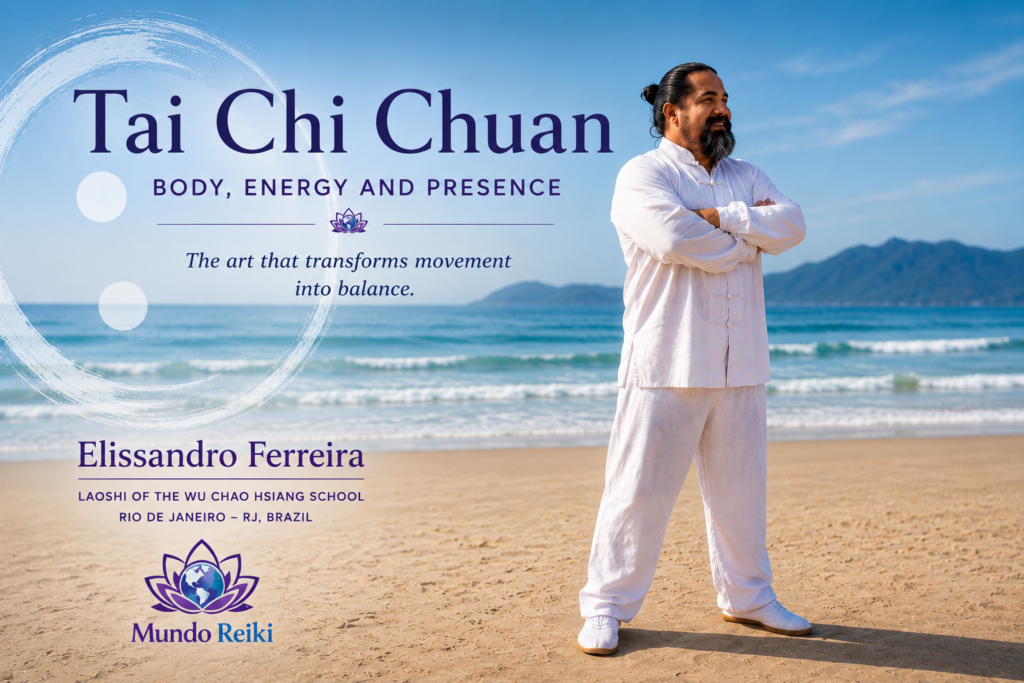
The Art of Abdominal Breathing and Activating the Lower Dantian in Tai Chi Chuan
By Elissandro Ferreira – Laoshi of the Wu Chao Hsiang School
There is much to share in this first encounter with the noble art of Tai Chi Chuan. However, I have chosen to begin our journey with one of its most essential foundations—one that is also considered one of the greatest challenges for practitioners: breathing.
At first glance, breathing seems like a simple and completely automatic act. Indeed, the body performs it instinctively. Yet, just as in other internal cultivation practices such as deep meditation and Yoga, breathing in Tai Chi Chuan requires awareness, technique, and refinement. So, let us set aside our haste and begin at the beginning.
The Lower Dantian and the Elixir of Vitality
As the starting point for developing our “elixir” and activating the Lower Dantian, we use abdominal breathing, also known as diaphragmatic breathing. To understand the importance of this practice, we must first become familiar with the map of our own energetic anatomy.
What Is the Lower Dantian?
Located approximately four finger-widths below the navel, at the center of the abdominal cavity, the Lower Dantian is the primary energy center in Tai Chi Chuan. It serves as the body’s true center of gravity, generating, storing, and regulating vital energy (Qi), which flows through every movement.
Later, when we study the Three Treasures (San Bao: Jing, Qi, and Shen), we will return to this concept in greater depth.
The Descriptive Anatomy of the Diaphragm
For breathing to fulfill its energetic function, it is essential to understand the physical engine behind it: the diaphragm.
From the perspective of descriptive anatomy, the diaphragm is a single, asymmetrical muscle that separates the thoracic cavity from the abdominal cavity. It consists of two main portions: a muscular peripheral portion, through which it attaches to the rib cage and vertebral column, and a central tendinous portion.
Shaped like a dome with its concavity facing downward, the diaphragm is composed of fine muscular fibers arranged around the periphery, whose interwoven central tendons form the central tendon. Structurally, its muscular portion is divided into three regions: vertebral, costal, and sternal.
Understanding this musculature allows us to visualize the mechanical movement that supports the invisible flow of energy.
Cultivating Qi: The Yin and Yang of Practice
When we breathe correctly during martial practice, we engage in genuine energy training. This process significantly increases the body’s vitality and promotes a harmonious flow of energy.
We may regard this balanced alternation between expansion and contraction as the very expression of Yin and Yang within Qi Gong (the cultivation of vital energy).
The Practice: Step by Step
To begin your daily practice, assume a relaxed posture and follow these instructions calmly.
1. Assume the Posture
Adopt the posture known as the Infinite Principle (or the Void). Place your left hand gently over the Lower Dantian and rest your other hand softly on top. Keep your entire body balanced and relaxed.
2. Emptying (Yin)
Gently contract your abdomen without forcing it, and slowly empty it while mentally counting to six seconds as you exhale. At the end of the exhalation, remain empty for two seconds.
3. Filling (Yang)
Over the next six seconds, inhale slowly, allowing the abdomen to expand naturally back to its original position. At the end of the inhalation, gently retain the breath for another two seconds.
Frequency and Benefits
This entire cycle should be performed continuously, slowly, and with great softness. I recommend repeating the sequence 10 to 36 times each day. By maintaining this routine for at least two weeks, the process will gradually become integrated into your body and feel completely natural.
As your practice develops, you will realize that you are building the solid foundation required to introduce the dynamic movements of Tai Chi Chuan. The physical and mental changes will become evident: a calmer and more focused mind, along with a body filled with renewed and vibrant energy.
In a future article, we will explore the origins of modern practice, its benefits, and additional exercises to deepen your understanding of breathing.
Continue Your Tai Chi Chuan Journey
Tai Chi Chuan is an art built upon strong foundations. Each stage of practice deepens the understanding of the body, the mind, and the cultivation of vital energy (Qi). If this article inspired you, continue exploring Elissandro Ferreira’s articles published on Mundo Reiki.
Knowledge, Discipline, and Presence: Elissandro Ferreira’s Journey
Discover the author’s background, training, and lineage, and learn how tradition, discipline, and presence shape his approach to teaching this ancient martial art.
👉 https://mundoreiki.com.br/elissandro-ferreira-tai-chi-chuan/
Why Practicing Tai Chi Chuan Will Change Your Life
Explore how this ancient practice promotes physical balance, mental clarity, emotional well-being, and the harmonious cultivation of vital energy.
👉 https://mundoreiki.com.br/why-practicing-tai-chi-chuan-will-change-your-life/
About the Author
Elissandro Ferreira is a Laoshi of the traditional Wu Chao Hsiang School of Tai Chi Chuan in Rio de Janeiro, Brazil. For the past eight years, he has dedicated himself to the study, practice, and teaching of this ancient martial art, preserving the teachings of his lineage while promoting an approach that integrates tradition, body awareness, and human development.
Graduated in Design and currently studying Physical Education, he also serves as an official Tai Chi Chuan referee, combining contemporary academic knowledge with traditional martial wisdom to provide instruction that is technically sound, accessible, and faithful to the origins of Tai Chi Chuan.
At Mundo Reiki, he writes about Tai Chi Chuan, Qi Gong, Eastern philosophy, and the cultivation of vital energy (Qi), making traditional knowledge accessible to modern readers and demonstrating how these practices contribute to holistic health, balance, serenity, and self-awareness.
📍 Rio de Janeiro – RJ, Brazil
References
Wong Kiew Kit. The Complete Book of Tai Chi Chuan.
P.-E. Souchard. The Diaphragm.
Reiki Continues.
Every article is an invitation to deepen your understanding of Reiki as a method, a practice, awareness and integral care.
Presence • Awareness • Care • Integrality