Qi Gong: Presence, Vital Energy and Inner Reorganization
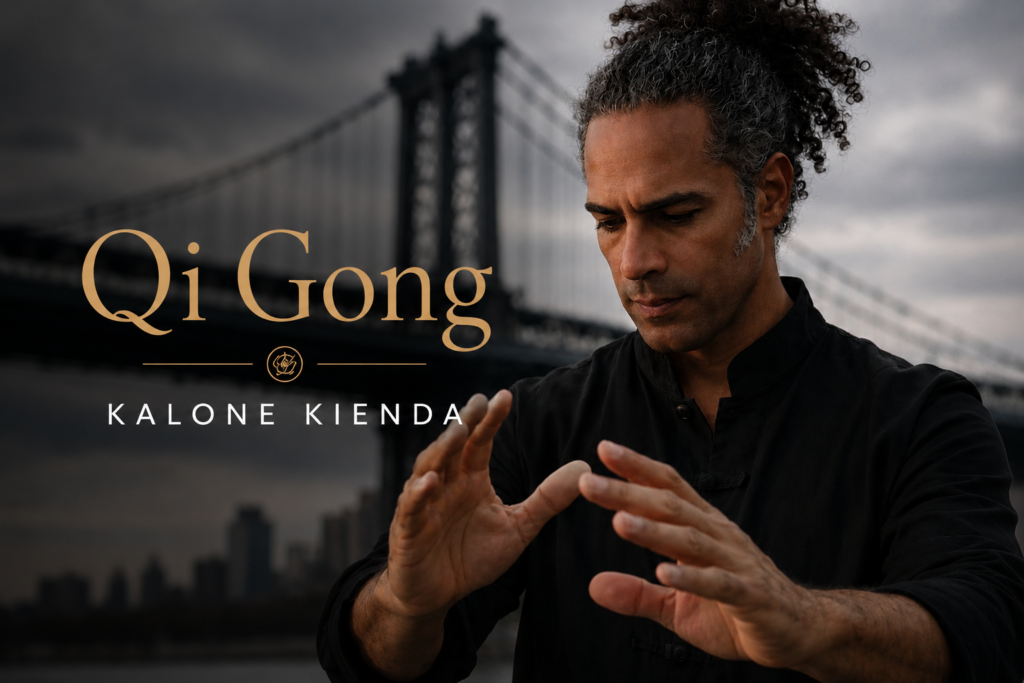
The contemporary world has accelerated the body, fragmented attention, and distanced many people from their own inner perception. We live within routines marked by overstimulation, emotional tension, hyperconnectivity, anxiety, and the constant depletion of physical and mental energy.
Within this context, ancient practices such as Qi Gong become increasingly relevant in a profound and contemporary way.
More than slow movements or breathing exercises, Qi Gong represents an integrated practice of presence, perception, breathing, body awareness, and energetic reorganization.
According to instructor Kalone Kienda, Qi Gong is a powerful tool for emotional and energetic harmonization through the conscious cultivation of vital energy.
“When emotions, the body, and the internal organs return to working in balance, our vital energy naturally reorganizes and strengthens itself.”
This perspective connects Qi Gong not only to Chinese tradition, but also to a broader and more contemporary understanding of integrative health.
What is Qi Gong?
Qi Gong is a traditional Chinese practice developed thousands of years ago, based on the cultivation and circulation of Qi — understood as vital energy.
The word may be understood as:
- Qi = vital energy
- Gong = cultivation, development, or continuous practice
In practice, Qi Gong integrates:
- Conscious breathing
- Body movement
- Mindful attention
- Posture
- Relaxation
- Presence
- Inner perception
Its purpose is not only physical strengthening, but also the balance between body, mind, emotions, and energy.
The body influences the mind
One of the greatest contributions of traditional Eastern practices lies in the understanding that body, emotions, breathing, and mind function as an integrated system.
When the body remains under constant tension, breathing changes.
When breathing changes, the nervous system responds.
When the nervous system becomes dysregulated, emotions and behavior are also affected.
Everything reverberates.
Qi Gong acts precisely within this process of reorganization.
Through conscious movement, breathing, and presence, practitioners begin to slow down automatic patterns of tension and overstimulation.
Over time, this may support:
- Greater sense of presence
- Emotional regulation
- Improved body awareness
- Stress reduction
- Better breathing quality
- Increased vitality
- Greater mental clarity
- Energetic balance
Medical Qi Gong and inner cultivation
Among the different Qi Gong lineages, some traditions have a stronger therapeutic and internal focus.
Kalone Kienda’s studies are especially connected to Medical Qi Gong, including practices from the Nei Yang Gong and Yi Zhi Chan traditions.
These approaches deeply work with:
- Breathing
- Internal relaxation
- Energy circulation
- Body awareness
- Emotional regulation
- Cultivation of presence
- Energetic sensitivity
The goal is not performance or competition.
The practice unfolds as a gradual process of inner refinement and human reorganization.
A contemporary practice for a hyperstimulated world
The excess of information and digital stimulation has profoundly changed our relationship with attention, silence, and presence.
Many people live in a constant state of acceleration, without perceiving their own body, breathing, or the emotional impact of daily life.
Within this scenario, integrative practices such as Qi Gong offer something increasingly rare:
pause.
A pause that does not represent escaping reality, but reconnecting with it.
Qi Gong does not propose isolation from the modern world.
It proposes reorganizing the way we live within it.
Breathing better.
Perceiving the body.
Reducing tension.
Cultivating presence.
Developing awareness.
Small movements can generate profound changes in the way we feel, think, and live.
Tradition, experience, and continuity
Much of Kalone Kienda’s training was developed through in-person experiences with Chinese masters and European instructors, while continuously studying since 2015 with the Institute of Chinese Medicine of Barcelona.
His work integrates tradition, practical experience, and ongoing deepening in Chinese energetic arts.
More than teaching techniques, his work seeks to support a real experience of presence, balance, and inner development.
About the Author
Kalone Kienda is a Qi Gong instructor who has dedicated more than 10 years to the study and practice of traditional Chinese energetic arts. Much of his journey was developed through in-person training with Chinese masters and European instructors, with a special focus on Medical Qi Gong and inner cultivation practices.
Since 2015, he has continued his studies with the Institute of Chinese Medicine of Barcelona, deepening his work in Nei Yang Gong, Yi Zhi Chan, breathing practices, meditation and energetic development.
His work integrates presence, body awareness, emotional balance and vital energy through practices that connect traditional wisdom with contemporary human experience.
Special Series — The Origins of Reiki
Mikao Usui, Mount Kurama, Gokai, Gakkai and the expansion of Reiki to the West.
Mikao Usui and the Meiji Era ⛰️ Article 2
Mount Kurama Awakening ☸️ Article 3
Reiki Principles (Gokai) 🌏 Article 4
Gakkai and Expansion 🌉 Article 5
Hayashi and Takata
🌎 Explore this series in other languages