Psychoaromatherapy: When Aromas Meet Emotions
Shana Ellwanger
Have you ever smelled an aroma and, within a few seconds, been transported to a memory, a person, or a specific moment in your life?
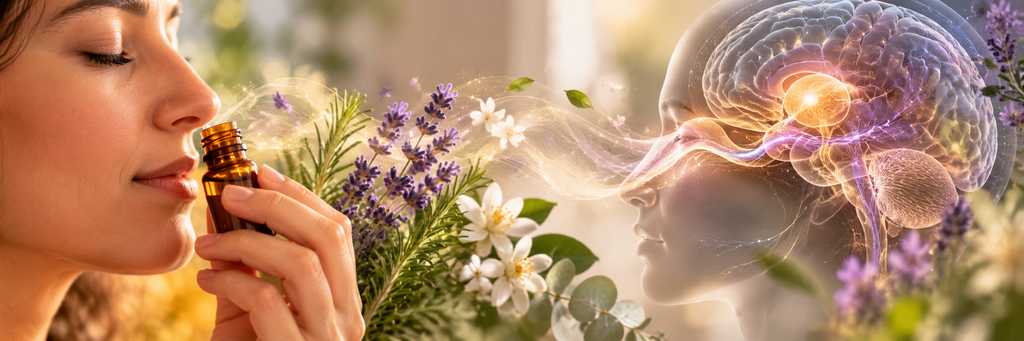
The smell of a cake baking, a plant, a perfume, or even a house can awaken sensations and memories that seemed forgotten. This happens because the sense of smell has a particularly close relationship with areas of the brain involved in processing emotions and memories.
It is precisely in this territory that we find Psychoaromatherapy: an approach that seeks to understand and explore the relationship between the aromas of essential oils, sensory experiences, and the emotional world.
Aroma Is More Than Just a Smell
When we inhale an aromatic molecule, it interacts with the olfactory receptors in the nose.
The information captured by the olfactory system is transmitted to the brain and may participate in processes related to perception, memory, emotion, and behavior.
That is why certain aromas can trigger very different subjective responses from one person to another.
Lavender, for example, may be perceived by one person as comforting and relaxing, while another may associate it with a specific memory or simply not enjoy its scent.
This individuality is fundamental when we talk about Psychoaromatherapy.
Aromas and Memories
One of the most interesting characteristics of the sense of smell is its ability to evoke memories in an intense and often unexpected way.
This helps explain why an aroma can remind us of our grandparents’ house, a trip, a loved one, or a particular period of our lives.
In aromatherapy practice, this characteristic can be observed and used as part of an experience of self-care and emotional awareness.
This does not mean that an essential oil can “erase” an emotion or determine how a person will feel. The response depends on many factors: personal history, context, scent preference, expectations, and even the way the aroma is presented.
What Does Science Investigate?
The relationship between aromas and well-being has been studied in different contexts, including research on stress, anxiety, sleep, pain, and quality of life.
Some studies point to promising results for certain essential oils and specific situations, particularly in relation to perceived relaxation and anxiety reduction. However, results still vary according to the oil used, concentration, method of application, context, and participant profile.
For this reason, it is important to avoid statements such as “this oil treats anxiety” or “this aroma cures depression.”
Aromatherapy can be understood as a complementary practice, rather than a substitute for medical or psychological care when such care is needed.
The Importance of Individual Experience
In Psychoaromatherapy, there is not necessarily a universal aroma for a particular emotion.
Rather than simply asking, “Which oil is recommended for anxiety?”, we can broaden the question:
“What does this aroma awaken in you?”
An aroma can become an invitation to observe: What do I feel when I notice this scent? What memory comes to mind? Does my body relax or become alert? Do I like this aroma? Does it bring me comfort or discomfort?
From these perceptions, the use of aroma can become a more conscious and individualized experience.
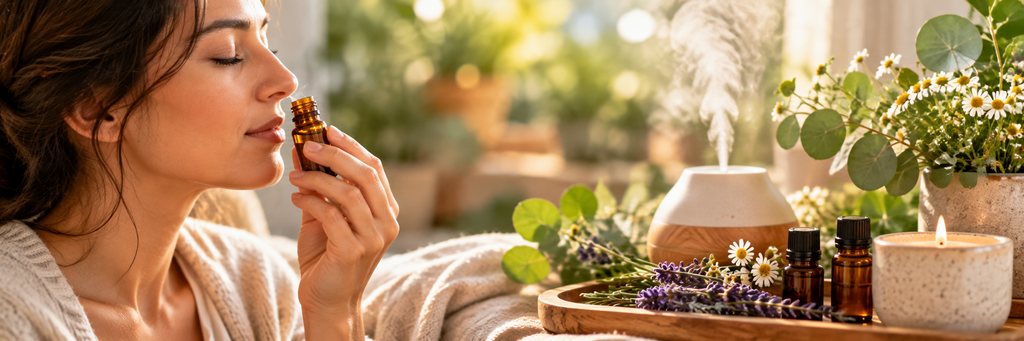
Aromatherapy Is Also About Presence
In a routine marked by an excess of stimuli, taking a few minutes to consciously breathe in an aroma can create a small pause.
And perhaps this is one of the most interesting aspects of Psychoaromatherapy: not looking at essential oil merely as a product, but at the sensory experience it provides.
An aroma can accompany a moment of relaxation, a meditation practice, a self-care ritual, or simply a pause during the day.
The goal is not to force an emotion to disappear, but to create space to notice what is happening.
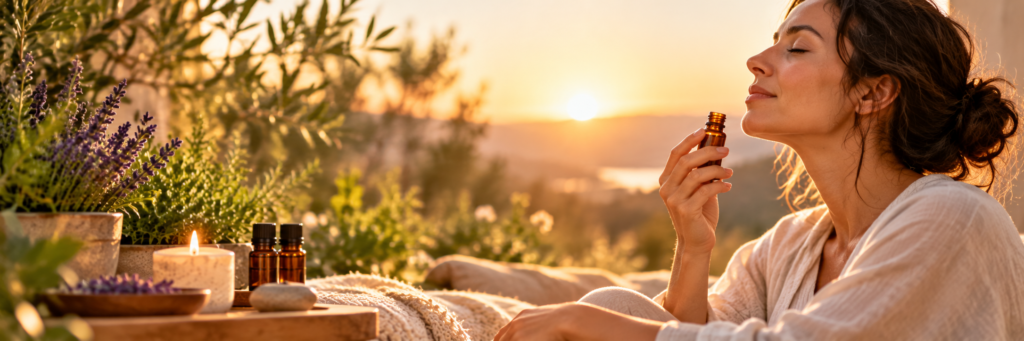
Aroma as an Invitation to Look Within
Psychoaromatherapy reminds us that the sense of smell is also part of our personal history.
Scents are part of our experiences, our environments, and our memories. And precisely because of this, working with aromas requires sensitivity and respect for individuality.
Perhaps you have an aroma you always seek when you need to slow down.
Or perhaps there is a scent you avoid because it awakens a difficult memory.
In both cases, there is a story.
And it is in this meeting point between aroma, memory, perception, and emotion that Psychoaromatherapy finds its place.
After all, sometimes all it takes is an aroma to open a door within us.
Until the next aroma…
May every aroma be an invitation to feel, perceive, and reconnect with yourself.
About the Author
Shana Ellwanger
Shana Ellwanger is an integrative therapist and aromatherapist, passionate about the world of aromas and the possibilities of care they can offer.
Her professional journey began in the field of Law and later led her into the world of integrative therapies, where she found in Aromatherapy a form of care that brings together knowledge, sensitivity, and a deep relationship between aromas, emotions, and well-being.
Her work encompasses different integrative practices, including Aromatherapy, Reiki, Foot Reflexology, Tui Na, Tok Sen, Chromotherapy, Flower Essences, and Spiritual Geobiology, always seeking to understand the human being as a whole.
Shana Ellwanger
Integrative Therapist
Aromatherapist & Psychoaromatherapy