Do You Have the Courage to Cross “the Great Water”?
Ink in a Liquid Medium in Art Therapy: The Metaphor of the Great Water
59. HUAN / DISPERSION (DISSOLUTION)
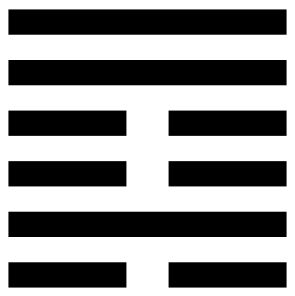
Above: SUN, THE GENTLE, WIND.
Below: K’AN, THE ABYSMAL, WATER.
DISPERSION. Success.
The king approaches his temple.
It is favorable to cross the great water.
Perseverance furthers.
(Wilhelm, 2006, p. 179)
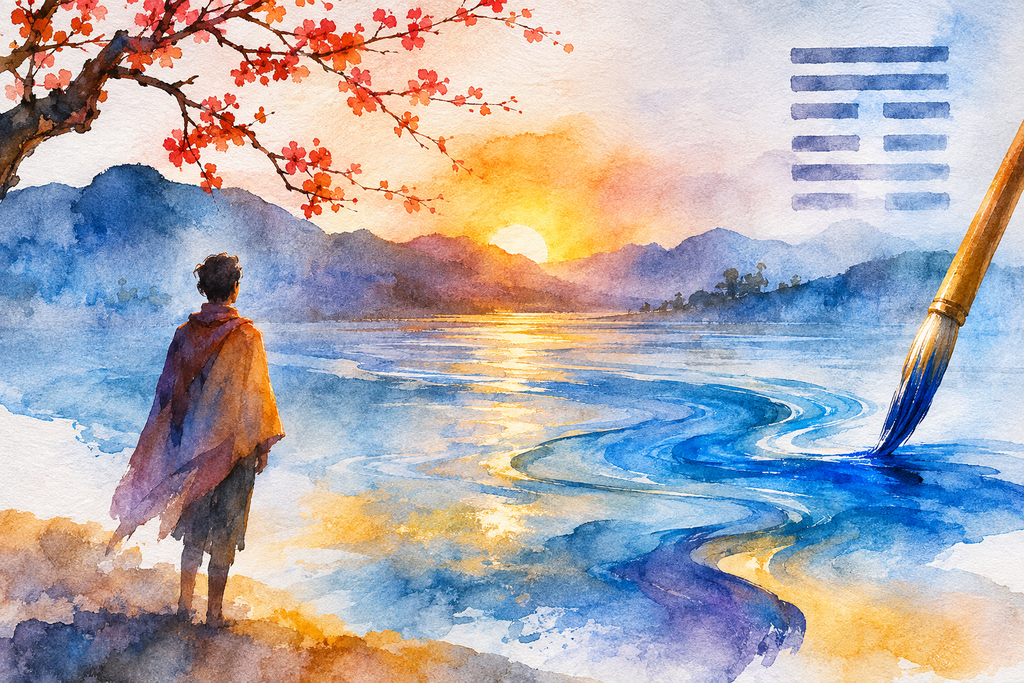
In art therapy, ink in a liquid medium speaks more about your emotions and your unconscious world than you might imagine. In ancient classical Chinese thought, the Great Water is a metaphor used in the book of wisdom and knowledge known as the I Ching. It carries an immensely powerful symbolic image that lives within us, although we may not be aware of it.
The patient is unaware that the obstacle to be overcome lies within herself: it is a borderline area, difficult to cross, which stands in the way of the continuity of the process. Nevertheless, it is possible to cross the boundary. […] The dream is showing the patient that there is something within her that prevents her from crossing the boundary, that is, from moving from one situation or attitude to another. […] Understanding the language of dreams naturally requires abundant parallels drawn from the psychology of primitive and historical symbolism, because dreams essentially originate in the unconscious, which contains the residual possibilities of the functions of all earlier periods in the history of evolution. In this sense, we have the classic example of the “crossing of the great water” in the oracles of the I Ging.
(Jung, 2011a, § 132, pp. 119–120)
Just like dreams, artistic expression in art therapy uses the same metaphorical language, since imagination and fantasy also “essentially originate in the unconscious” (Jung, 2011a, p. 119). These images that make up the psyche “contain the residual possibilities of the functions of all earlier periods in the history of evolution” (Jung, 2011a, p. 119), which we call archetypes. The “great water” to be crossed is one of these archetypal images, present in the ancestral Chinese imagination of the I Ching and cited by Jung. Therefore, in the Jungian art therapy setting, every process of profound transformation can be understood as crossing the “Great Water”, a journey that requires preparation, courage, and the right time for maturation.
Art therapy offers resources for the preparation and the necessary tools to cross the great water. This, in turn, can symbolize the unconscious and emotions in their purest state, allowing us to fully feel and experience what needs to be lived. As Jung points out: “Water is the commonest symbol for the unconscious. […] The descent into the depths always precedes the ascent.” (CW 9i, p. 40). However, this is precisely where we tend to create barriers, block the flow, and regress. We avoid crossing this threshold because it seems too frightening and immense, exactly as indicated by the “Sung/Conflict” hexagram in the I Ching:
SUNG / CONFLICT
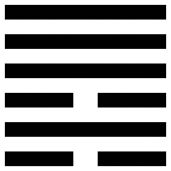
Above: CH’IEN, THE CREATIVE, HEAVEN.
Below: K’AN, THE ABYSMAL, WATER.
JUDGMENT
CONFLICT. You are sincere and are being obstructed.
Cautiously stopping halfway brings good fortune.
Going through to the end brings misfortune.
It is favorable to see the great man.
It is not favorable to cross the great water.
(Wilhelm, 2006, pp. 45–46)
This is where Jungian art therapy work with ink comes in. We can approach these contents through the fluidity and liquidity of water and ink: through flowing, dripping, and trickling; through the stains of watercolor, acrylic ink, and so many other possibilities; through natural dyes, pigments, and coloring materials. When we use these materials therapeutically, under the guidance of a qualified art therapist, we mobilize, within our related symbolic contents, what has become sedimented, calcified, stagnant, or blocked. Emotions become liquid, overflow, and find a way to flow out. What has had its flow interrupted, what has been dammed up, can find in fluid ink a way to set psychic energy in motion again, releasing what had become stagnant and obstructed.
In art therapy literature, Ângela Philippini (2001, p. 65) emphasizes that creative activity has precisely the purpose of giving form and materiality to “psychic energy that is blocked and needs to be released and flow”, recovering the symbolic memory “of waters that, flowing, moistened, dissolved, purified […] and that, colored, in COLOR-action painted offerings, feelings, and desires” (Philippini, 2001, p. 68). Unlike dry materials, which offer precision and rational control over the stroke, painting in a liquid medium invites us to let go of the ego’s rigid control. As studies in the field point out, “among the expressive modalities in art therapy, painting is the one that allows emotions to flow most freely, because the fluidity of the ink and its liberating function induce a movement of release and expansion, helping to relax defensive mechanisms of control” (Valladares; Carvalho, 2005, p. 35).
“Regression is, as it were, a damming up of vital energy […] The libido flows backward, awakening contents that had until then been dormant in the unconscious.” (Jung, 2011c).
Generally, these contents seek to manifest themselves in us through raw, unfiltered emotions, such as anger, sadness, feelings of misunderstanding and disbelief, rejection and nonconformity, disappointment, betrayal, among many others that we could never fully list. We try to prevent ourselves from feeling these emotions because, after all, they destabilize us and often conflict with what we have learned and understand as acceptable ways of acting and feeling.
From an early age, we learn that it is wrong to feel anger. Yet we can all agree that irritation, rage, or chronic anger often lives within us, never leaving us, and that apparently we must constantly keep it under control, without ever being able to release it. We try to swallow these emotions in order to maintain the social mask that allows us to adapt to life in society (our persona), but these repressed waters take on a life of their own in the unconscious. Until one day they take us by surprise: we explode in an outburst of rage, and the “complexes” take hold of us. “We do not have complexes; the complexes have us.” (Jung, 2011d, § 200, p. 49).
We say more than we would have liked to say, express what we are feeling in an exaggerated way, amplifying our anger through words and perhaps even actions that we later regret.
Therefore, in order to prepare ourselves to cross the Great Water of our unconscious contents without allowing them to reach the point of overflowing and exploding like a geyser, a pressure cooker, or an erupting volcano, perhaps the best strategy is to begin looking at our blocked waters little by little, with support and guidance throughout the process. After all, as Jungian analyst Verena Kast (1997, p. 47) reminds us, “the way to deal with complexes cannot be one of defense or control; rather, it involves allowing the complexes to unfold in fantasies, seeing and understanding them in patterns, and then incorporating them into consciousness through work with the symbol.” Within the safe container of the art therapy setting, gradually giving these waters an outlet through ink prevents destructive overflow, because “art reduces the emotional charge of images, sometimes terrifying ones, and makes it possible to decode them in terms of internal reorganization and the reconstruction of reality” (Diniz, 2015, p. 12).
Not waiting until we need help, when everything has already gotten out of control, is perhaps the best strategy. Crossing the great water requires the courage to leave the safe shore of rationality and dive into the flow of life’s transformation. In my art therapy practice, ink in a liquid medium is used precisely to mobilize and engage with these unconscious contents, bringing them to the surface in a creative and constructive way, rather than allowing them to assume the destructive character they take on when we ignore them.
References
DINIZ, Lígia. Mitos e arquétipos na arteterapia: os rituais para se alcançar os deuses. Rio de Janeiro: Wak Editora, 2015.
JUNG, Carl Gustav. Psicologia do inconsciente. 20th ed. Petrópolis: Vozes, 2011a. (Collected Works of C. G. Jung, vol. 7/1).
JUNG, Carl Gustav. Os arquétipos e o inconsciente coletivo. 7th ed. Petrópolis: Vozes, 2011b. (Collected Works of C. G. Jung, vol. 9/1).
JUNG, Carl Gustav. Símbolos da transformação. 7th ed. Petrópolis: Vozes, 2011c. (Collected Works of C. G. Jung, vol. 5).
JUNG, Carl Gustav. A natureza da psique. 8th ed. Petrópolis: Vozes, 2011d. (Collected Works of C. G. Jung, vol. 8/2).
KAST, Verena. A dinâmica dos símbolos: fundamentos da psicoterapia junguiana. São Paulo: Loyola, 1997.
PHILIPPINI, Ângela. Cartografias da coragem: rotas em arteterapia. 2nd ed. Rio de Janeiro: Pomar, 2001.
VALLADARES, Ana Cláudia Afonso; CARVALHO, Ana Maria Pimenta. Art therapy approaches in the care of hospitalized children. Revista Eletrônica de Enfermagem, Goiânia, vol. 7, no. 1, pp. 30–37, 2005.
WILHELM, Richard. I Ching: o livro das mutações. Translated by Alayde Mutzenbecher and Gustavo Alberto Corrêa Pinto. São Paulo: Pensamento, 2006.
Faruk Silva
Jungian Art Therapist
Carlos Alberto Faruk Abu Laila Silva, professionally known as Faruk Silva, is a Jungian art therapist and educational advisor, working in the socio-emotional development of teachers and students.
With nearly 20 years of experience in bilingual education and language teaching, he has worked as a teacher and pedagogical coordinator. His professional journey sparked his interest in understanding the emotional and human dimensions underlying learning processes, leading him to deepen his studies in Jungian psychology and art therapy.
He is co-founder of Instituto Contos Ancestrais (ICA®), where he develops projects that bring together traditional storytelling and art therapy, including the Institute’s original approach known as conto-arteterapia. His work includes individual sessions, workshops, and courses focused on creative expression, self-knowledge, and personal transformation.
Location: São Paulo, Brazil.