Brain Rot: when overstimulation starts reorganizing your mind
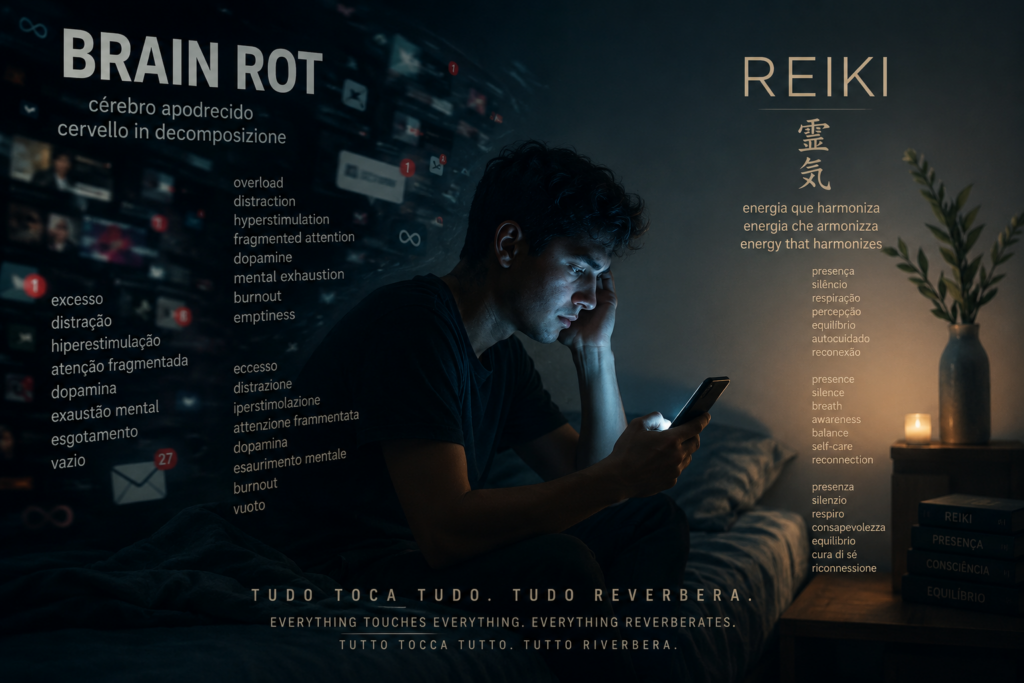
There is a silent sensation growing throughout contemporary life.
You open your phone “just for a few minutes.”
Then suddenly:
you have watched dozens of videos;
jumped between subjects;
forgotten half of what you consumed;
you feel tired;
anxious;
restless;
yet somehow unproductive at the same time.
Attention fragments.
The body slows down.
The mind accelerates.
And the sense of presence disappears.
This phenomenon has informally become known online as Brain Rot.
But perhaps the most important thing is not the term itself.
It is what the term reveals about contemporary human experience.
What is “Brain Rot”?
“Brain Rot” is not a medical diagnosis.
It is a cultural expression used to describe:
- excessive fast content consumption;
- constant overstimulation;
- cognitive saturation;
- difficulty sustaining attention;
- dependency on novelty;
- loss of perceptual depth.
It is not simply about “using your phone too much.”
It is about living in a continuous state of fragmentation.
The mind begins to operate through the logic of:
scrolling;
dopamine;
interruption;
micro-stimulation;
instant reward;
constant anxiety.
And this reverberates through everything.
Sleep.
Food.
Relationships.
Spirituality.
Productivity.
The ability to remain in silence.
Body awareness.
Presence itself.
Everything touches everything.
The problem is not only technological

The problem is not “the phone.”
The problem is the way the modern environment reorganizes human behavior, attention and perception.
Today we live inside a context of:
- information overload;
- infinite stimulation;
- constant notifications;
- permanent comparison;
- emotional acceleration;
- passive consumption;
- hyperconnectivity without presence.
The human brain did not evolve to process thousands of stimuli every day.
And the body feels it.
Anxiety.
Fatigue.
Distraction.
Impulsiveness.
Insomnia.
Sedentary behavior.
Emotional disorganization.
Not because people are “weak.”
But because the environment itself is training the nervous system toward hyperreactivity.
The body perceives before the mind understands

One of the great contemporary illusions is believing that everything can be solved simply by “thinking better.”
But often the body is already in perceptual collapse before consciousness fully realizes it.
Short breathing.
Restless eyes.
Difficulty slowing down.
Constant need for stimulation.
Inability to sustain silence.
The body begins to live in a continuous state of alertness.
And this changes:
- attention;
- emotion;
- memory;
- decision making;
- behavior;
- human relationships.
That is why contemporary reorganization may need to begin less through “information” and more through experience.
Less excess.
More presence.
Where does Reiki fit into this?
Within Mundo Reiki, Reiki is not presented as a spiritual escape from modern life.
Instead, it appears as a possibility for perceptual reorganization.
A practice that may help recover:
- presence;
- body awareness;
- silence;
- coherence;
- rhythm;
- self-care;
- self-regulation.
Not as a miracle.
Not as a promise.
But as a continuous practice of reconnecting with oneself.
Because perhaps one of the greatest contemporary illnesses is not anxiety alone.
But disconnection from oneself.
Presence has become a radical practice

Today, remaining present for even a few uninterrupted minutes has become difficult for many people.
Sitting in silence.
Breathing.
Perceiving the body.
Feeling the environment.
Sustaining attention.
All of this has become a form of training.
And perhaps this is one of the most important aspects of contemporary integrative care:
learning how to perceive again.
Promoting health before collapse
Perhaps the future of care is not only about treating symptoms.
But about reorganizing context, behavior and presence before exhaustion becomes illness.
Sleep.
Light.
Movement.
Breathing.
Environment.
Rhythm.
Nutrition.
Relationships.
Silence.
Pause.
Self-care.
Everything reverberates.
Health does not emerge from a single factor.
It emerges from integration.
Conclusion
Brain Rot is not only about the internet.
It is about what happens when human beings lose internal continuity.
When there is excessive stimulation and very little presence.
Too much consumption and too little integration.
Too much information and too little real experience.
Perhaps the contemporary challenge is not “disconnecting from the world.”
But learning how to inhabit life again with awareness.
And perhaps care begins exactly there.
— Ruy Fernando Morelli
Mundo Reiki
Special Series — The Origins of Reiki
Mikao Usui, Mount Kurama, Gokai, Gakkai and the expansion of Reiki to the West.
Mikao Usui and the Meiji Era ⛰️ Article 2
Mount Kurama Awakening ☸️ Article 3
Reiki Principles (Gokai) 🌏 Article 4
Gakkai and Expansion 🌉 Article 5
Hayashi and Takata
🌎 Explore this series in other languages